External sources open in a new window.
Start with the actual document and stage. A foreign national’s criminal case in mainland China has separate rules for detention, arrest, prosecution and trial. “37 days” is a conditional combination, not a universal release date. Ask for interpretation and consular contact, and arrange qualified PRC counsel promptly.
Prepared by Wang Guan, Attorney at Law, Beijing Hoolaw Law Firm | PRC lawyer’s practice certificate: 11101202111297085.
2026 edition · v1.1 | First published: 20 October 2026 | Revised: 24 October 2026. English guide with a 25-term Chinese–English glossary.
Word: editable guide | PDF: read or print
The web page and downloads use the same revised text and tables. When quoting, credit the author, guide title, revision date and this page.
1. Who this guide is for
This guide is for foreign nationals, families, employers and foreign counsel dealing with an ordinary mainland Chinese criminal case, principally one investigated by the police. Administrative immigration detention, extradition, supervision-law investigations, juvenile cases and other special procedures require separate rules. The six broad stages below are an orientation, not a promise that every case follows the same route or duration.
The principal references are the 2018 Criminal Procedure Law (CPL), the 2021 Supreme People’s Court (SPC) Interpretation and the 2020 Police Procedural Provisions. English terminology here is explanatory and is not an official translation. Use the official Chinese text and actual case documents for decisions.
2. Six broad stages: time limits and qualifications
Read the period and the qualifications together. Months are not always interchangeable with 30-day blocks. CPL Article 105 governs counting periods, including the exclusion of the initial hour or day and special rules for holidays and custody.
| Stage | Period or requirement | Conditions and limits | CPL articles |
|---|---|---|---|
| Reporting and case filing 报案与立案 |
Articles 109–114 do not prescribe one universal filing-review period for every case. Applicable police rules and the type of case must be checked. | A report is received and reviewed; opening or refusing a case is distinct from detention. A complainant may seek reconsideration of a refusal; procuratorial case-filing supervision is addressed in Article 113. | 109–114 |
| Summons, compelled appearance and detention 传唤、拘传与刑事拘留 |
Summons or compelled appearance: generally no more than 12 hours; up to 24 hours only where the case is particularly serious and complex and detention or arrest is necessary. | After criminal detention, transfer to a detention house must occur immediately and no later than 24 hours; questioning is within 24 hours. Family notice is normally within 24 hours, subject to Article 85’s narrow exceptions. Summons and criminal detention are different measures. | 34, 39, 85–86, 119 |
| Request for arrest and arrest review 提请批捕与审查批捕 |
Police generally request approval within 3 days of detention, extendable by 1–4 days in special circumstances. For major suspects in roving, repeated or group crime, the request period may reach 30 days. The procuratorate has 7 days after receipt. | The 30 + 7 combination is conditional, not a common detention period for every case. If arrest is not approved, police must immediately release the person; qualifying bail or residential surveillance can be used while investigation continues. This does not automatically end the case. | 91 |
| Investigation after arrest 逮捕后侦查羁押 |
Normally 2 months; a complex case may receive 1 more month with next-level procuratorate approval. Article 158 allows 2 further months for four specified categories with provincial approval or decision. | Article 159 permits a further 2 months only where a sentence of 10 years or more may be imposed and investigation still cannot conclude after the Article 158 extension, with provincial approval or decision. Articles 157 and 160 contain special or recalculation rules: 2 + 1 + 2 + 2 is not a universal absolute ceiling. | 95, 156–161 |
| Review for prosecution 审查起诉 |
Normally 1 month, extendable by 15 days for a major, complex case. For a guilty plea qualifying for the expedited procedure: 10 days, extendable to 15 if a custodial sentence exceeding 1 year may be imposed. | Counsel can access the case file from this stage. Supplementary investigation is up to 1 month each time, at most twice, and the review period restarts on resubmission. After two rounds, insufficient evidence failing prosecution conditions requires non-prosecution. Check changes of jurisdiction separately. | 40, 172–177 |
| Trial and appeal 审判与上诉 |
Ordinary first-instance public prosecution: normally 2 months, no later than 3; a further 3 requires the specified grounds and higher-court approval, and further extension requires Supreme People’s Court approval. Second instance: normally 2 months, with a 2-month extension only on Article 243’s grounds and approval; further extension is referred to the Supreme People’s Court. | Simplified trial: 20 days, extendable to 1.5 months if imprisonment exceeding 3 years may be imposed. Expedited trial: 10 days, extendable to 15 if imprisonment exceeding 1 year may be imposed; eligibility must be checked. Appeal: 10 days for a judgment or 5 for a ruling, from the day after receipt. Article 237’s protection has exceptions. | 105, 187, 208, 214–225, 227, 230, 234, 237, 243 |
Measures can cross stages: bail pending trial (取保候审) is capped at 12 months and residential surveillance (监视居住) at 6 months under Article 79. Investigation, prosecution and trial continue; these are not a total limit on the case. Residential surveillance is normally at the residence; a designated place is subject to Article 75’s conditions. Where a coercive measure expires, Article 99 requires lawful release, termination or change of measure without waiting for a family application.
After judgment: execution, death-sentence review and a later retrial are distinct procedures. The SPC approves immediate execution death sentences; high courts approve suspended death sentences (Articles 246 and 248). Article 264’s 10 days concerns delivery of execution documents, not guaranteed transfer to prison within 10 days. A petition does not itself reopen a case or stop execution (Article 252).
3. First practical steps for a family or employer
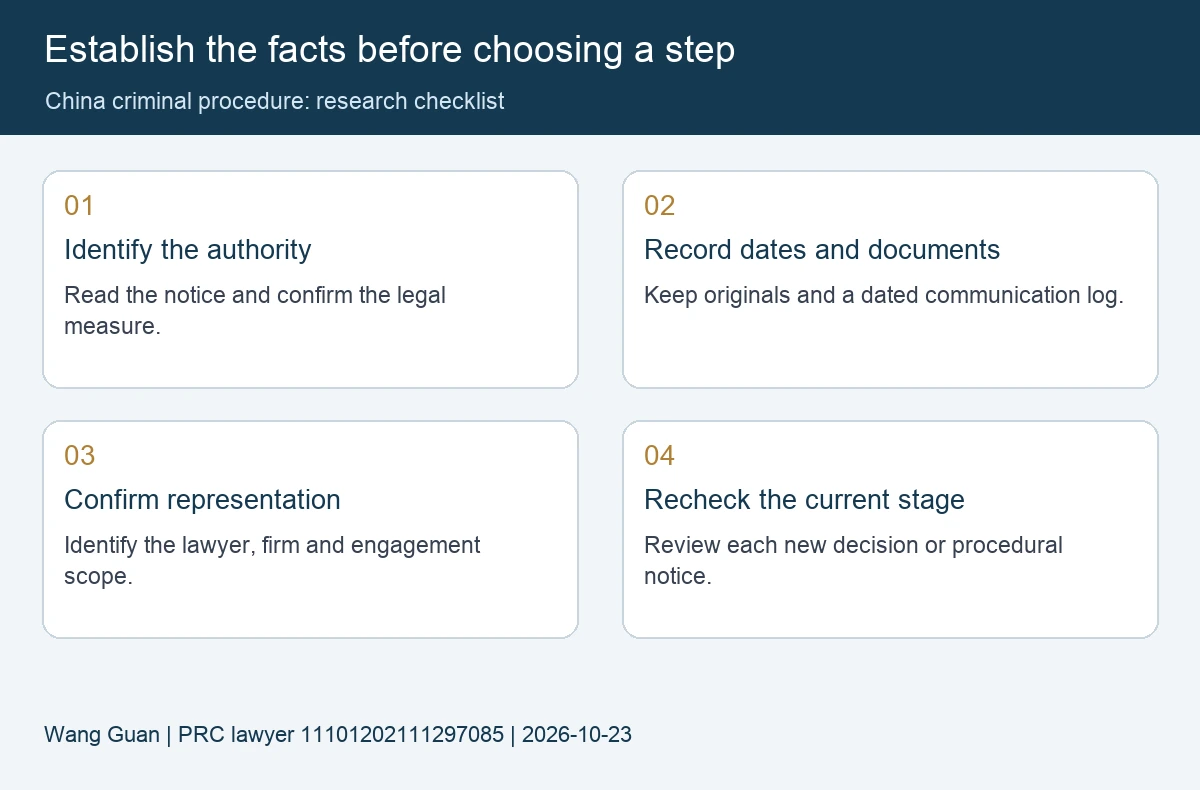
- Locate and identify: record the person’s passport details, nationality, language, authority, custody location, suspected offence and latest document. Verify detention, arrest and service dates separately.
- Arrange counsel: verify the PRC lawyer’s practice certificate and law firm. A detained person’s close relatives or guardian may retain counsel under Article 34. Foreign-defendant court-stage rules, including consular assistance in retaining a defender, appear in SPC Interpretation Article 485.
- Request language and consular support: specify the language needed and the relevant consulate. Keep these distinct from family notification and lawyer meetings.
- Preserve facts and health information: collect genuine documents, medication needs and contact details; keep submission receipts. Do not delete records, coach witnesses or contact co-suspects to coordinate accounts.
- Track the next decision: review arrest submissions, later custody review, file access, pleas and appeals at their actual stages. There is no basis for saying that only three points can affect the outcome.
4. Ten rights, with their limits
- Understand the proceeding. Request an interpreter if Chinese is not understood. Questioning and court documents have specific rules; an English-speaking colleague is not a substitute for a properly arranged interpreter (Police Provisions Article 361; SPC Interpretation Article 484).
- Retain a defence lawyer. The suspect may appoint a defender from the first investigative questioning or the application of a coercive measure; during investigation the defender must be a lawyer (CPL Article 34).
- Meet counsel. A defence lawyer uses the documents required by Article 39; the detention house must arrange a meeting promptly and no later than 48 hours. Investigative meetings in state-security or terrorist-activity cases require permission. Counsel meetings are not monitored.
- Family notification. Detention notice is normally within 24 hours. Article 85 exceptions concern inability to notify, or state-security or terrorist-activity cases where notice may obstruct investigation. The latter reason ends when the obstruction disappears; it is not a general exception for every offence.
- Seek a change of measure. Eligible persons, including close relatives and the defender, may apply under Article 97; the authority decides within 3 days and gives reasons for refusal. Bail is subject to statutory conditions and is not guaranteed by nationality, payment or employment.
- Challenge continued custody. Article 95 addresses procuratorial review of the necessity of detention after arrest. Detention expiry, unlawful conduct and a request to change measures involve related but distinct remedies; none depends on waiting for a universal “37th day”.
- Challenge unlawful evidence, with an accurate account of questioning duties. Article 120 requires truthful answers to case-related questions and permits refusal of questions unrelated to the case. This is not a general right to silence on everything except identity. Article 52 prohibits compelling self-incrimination; Article 56 governs exclusion of unlawful evidence. Read records carefully and raise inaccuracies or translation problems.
- Read the file through counsel and make informed plea decisions. Defence lawyers have file-access rights from prosecution review under Article 40. Counsel should use those rights and explain the evidence, charge and sentencing proposal before advising on a plea. Do not present prior file reading as a statutory validity condition for every plea statement (Articles 173–174).
- Appeal on time. Article 230 sets 10 days for a judgment and 5 for a ruling, from the day after receipt. Article 237 protects a defendant-only appeal against increased punishment, but prosecutorial protest and private-prosecutor appeal are exceptions; remand also has statutory qualifications.
- Request consular contact. Vienna Convention Article 36 addresses notification without delay on request, information about that right, communication and consular visits. Bilateral consular treaties and Chinese notification rules must also be checked; consular support is different from a lawyer’s representation.
5. Issues specific to foreign nationals
Consular notification and visits
Police Procedural Provisions Articles 367–370 distinguish internal reporting, consular notification and visits. Article 367’s 48-hour requirement is an internal reporting requirement; it should not be quoted as a universal deadline for every consular notice. Article 368 refers to applicable consular treaties and relevant rules. At trial, SPC Interpretation Articles 479–482 govern notification and consular visits; Article 480 specifies treaty deadlines or, without one, prompt notice no later than 7 days in that court-stage rule.
A consulate can communicate, visit and help arrange representation under the applicable rules. It cannot direct the Chinese court to dismiss a case or replace PRC defence counsel.
Family meetings before final judgment
Family members do not have a defence lawyer’s meeting rights. However, Police Provisions Article 370 permits approved meetings with close relatives or a guardian during investigative custody. At trial, SPC Interpretation Article 482 provides an application route through the high court where the trial court is located, with relationship evidence under Article 486; the court may approve if the meeting will not obstruct trial. Check the current treaty and authentication route for documents sent from abroad. Do not assume either automatic access or an absolute ban until sentence execution.
Deportation, immunity and immigration
Criminal Law Article 35 permits deportation of a foreign national who commits a crime, independently or as an additional penalty. It is a sentencing issue and differs from administrative immigration measures. An exit restriction, bail obligations, deportation and future visa or residence decisions must be assessed separately; do not infer permission to leave or a fixed re-entry period from Article 35 alone.
Criminal Law Article 11 provides for diplomatic channels where foreigners enjoying diplomatic privileges and immunities incur criminal responsibility. Not every consular employee or foreign official has blanket personal immunity; status, the scope of immunity and the applicable instruments require verification by the competent authorities.
6. Chinese–English glossary: 25 terms
| 中文 | English | Meaning and limits |
|---|---|---|
| 立案 | case filing / opening a case | Formal decision to open a criminal case; different from receiving a report. |
| 传唤 | summons | Request to appear for questioning under the statutory procedure; not criminal detention. |
| 拘传 | compelled appearance | Compulsory appearance; duration is governed by Article 119. |
| 刑事拘留 | criminal detention | A criminal custodial measure; distinguish administrative detention. |
| 逮捕 | arrest | Arrest under the statutory approval or decision process; not simply the initial act of being taken into custody. |
| 取保候审 | bail pending trial | A non-custodial measure with a guarantor or security deposit; cases may continue. |
| 监视居住 | residential surveillance | Normally at the person’s residence; a designated place is permitted only under statutory conditions. |
| 批准逮捕 | approval of arrest | The procuratorate’s decision on a request for arrest approval. |
| 羁押必要性审查 | review of the necessity of continued detention | Article 95 concerns continued detention after arrest; not a guaranteed release. |
| 侦查终结 | conclusion of investigation | The investigation ends and the file may be transferred for prosecution. |
| 审查起诉 | review for prosecution | The procuratorate assesses whether to prosecute; counsel has file-access rights. |
| 退回补充侦查 | return for supplementary investigation | At the prosecution-review stage: up to two rounds of no more than one month each. |
| 不起诉 | non-prosecution | A decision not to indict; grounds and remedies differ by type. |
| 认罪认罚从宽 | leniency for pleading guilty and accepting punishment | A statutory leniency mechanism; not an automatic fixed sentencing discount. |
| 具结书 | written plea statement | A written statement on admitting guilt, accepting the sentencing proposal and applicable procedure; statutory exceptions exist. |
| 起诉书 | indictment | The charging document submitted to the court. |
| 庭前会议 | pre-trial conference | A procedure for addressing issues such as evidence and trial preparation; not every case has one. |
| 非法证据排除 | exclusion of illegally obtained evidence | Different rules apply to unlawful confessions and defects in physical or documentary evidence. |
| 上诉不加刑 | protection against increased punishment on appeal | Protection under Article 237; prosecutorial protest and private-prosecutor appeal are important exceptions. |
| 死刑复核 | death-sentence review | Immediate execution requires Supreme People’s Court approval; a suspended death sentence is approved by a high court. |
| 减刑 | commutation | Reduction of punishment under statutory conditions and procedures. |
| 假释 | parole | Conditional early release under statutory conditions and procedures. |
| 驱逐出境 | deportation | May be a criminal penalty under Criminal Law Article 35; distinguish administrative measures. |
| 法律援助 | legal aid | Legal assistance subject to eligibility rules; appointment is mandatory in specified cases. |
| 辩护人 | defender / defence counsel | A defence lawyer is one category of defender; other eligible persons may act where the law permits. |
7. Frequently asked questions
Q: Can a lawyer from the home country defend the person in a Chinese criminal court?
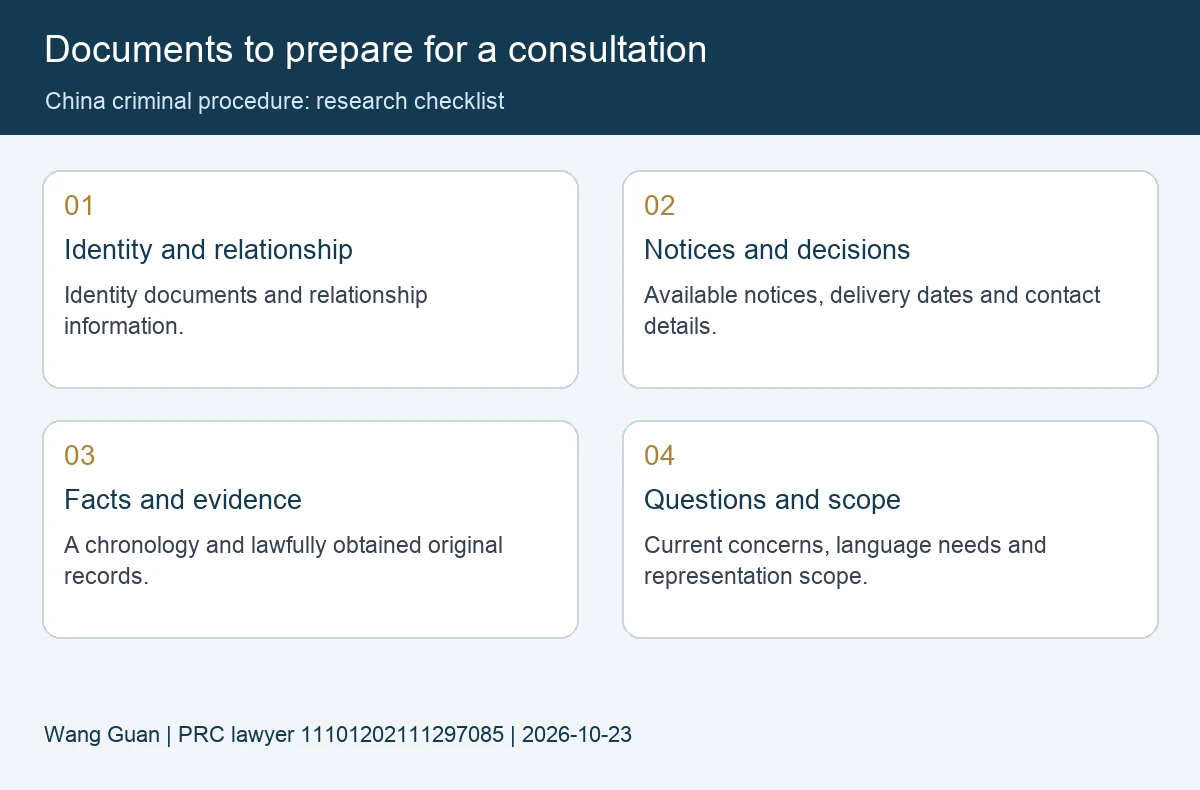
A: A lawyer retained as the defence lawyer must hold PRC lawyer qualifications and a valid PRC practice certificate. Foreign counsel can coordinate with PRC counsel within applicable professional rules, but their foreign licence alone does not authorise Chinese criminal advocacy. Separate rules allow certain eligible non-lawyer defenders.
Q: Can family members visit before the judgment takes effect?
A: There is no blanket ban throughout all pre-judgment stages. During police investigative custody, visits by close relatives or a guardian require police approval under Police Procedural Provisions Article 370. During trial, an application can be made through the high court under the 2021 SPC Interpretation Article 482; approval and relationship evidence are required. This differs from a defence lawyer’s meeting rights.
Q: Is interpretation available for a foreign national?
A: Yes. Proceedings use Chinese, with interpretation for those who do not understand it under the applicable rules. Police Procedural Provisions Article 361 addresses questioning; the 2021 SPC Interpretation Article 484 addresses trial interpretation and translated court documents. The official Chinese court document prevails; request the language assistance needed.
Q: Does compensation or a victim’s forgiveness end the case?
A: No. Those matters may be relevant to mitigation, settlement or a lawful non-prosecution decision, depending on the offence and facts. Payment does not automatically terminate a public prosecution or guarantee release.
Q: Does every detained foreign national have to wait 37 days?
A: No. The Article 91 combination of 30 days before an arrest request and 7 days for procuratorial review applies only where the specified conditions are met. Other cases have shorter request periods, and approval of arrest can lead to further lawful custody.
Q: Can the person leave China while the case is pending?
A: Do not assume so. Bail conditions and a separate exit restriction may prevent departure. A pending case, a criminal deportation order and an administrative immigration decision raise different issues; ask counsel to verify the actual measure, issuing authority and consequences.
Q: Is a statement automatically inadmissible if no lawyer was present?
A: No. PRC criminal procedure does not provide a general right to have a defence lawyer attend every police questioning. Article 56 requires exclusion of confessions obtained by torture or other unlawful methods within the statutory rules. Counsel should examine how the statement was obtained and preserve any interpreter or record-correction concerns.
Q: What if no lawyer has been appointed and the person cannot afford one?
A: Ask the legal-aid institution or case-handling authority about eligibility. CPL Article 35 provides for applications and mandatory appointment in specified cases, including a possible life sentence or death penalty without retained counsel. For foreign defendants, the court also has powers under the 2021 SPC Interpretation Article 485; appointment is not automatic solely because a person is foreign.
8. Official sources and translation policy
- CPL: official Chinese text, 2018 amendment, effective 26 October 2018. Article numbers in the stage table refer to this law.
- SPC Interpretation on applying the CPL (2021), effective 1 March 2021; especially Articles 475–488 on foreign-related cases.
- Police Procedural Provisions, 2020 revision (official police publication); especially Articles 361 and 367–370.
- Criminal Law: official Chinese base text; Articles 11 and 35 cited here. This older publication is not described as a current consolidated 2026 text.
- Vienna Convention on Consular Relations: UN English text, Article 36. Check the bilateral consular treaty for the person’s nationality.
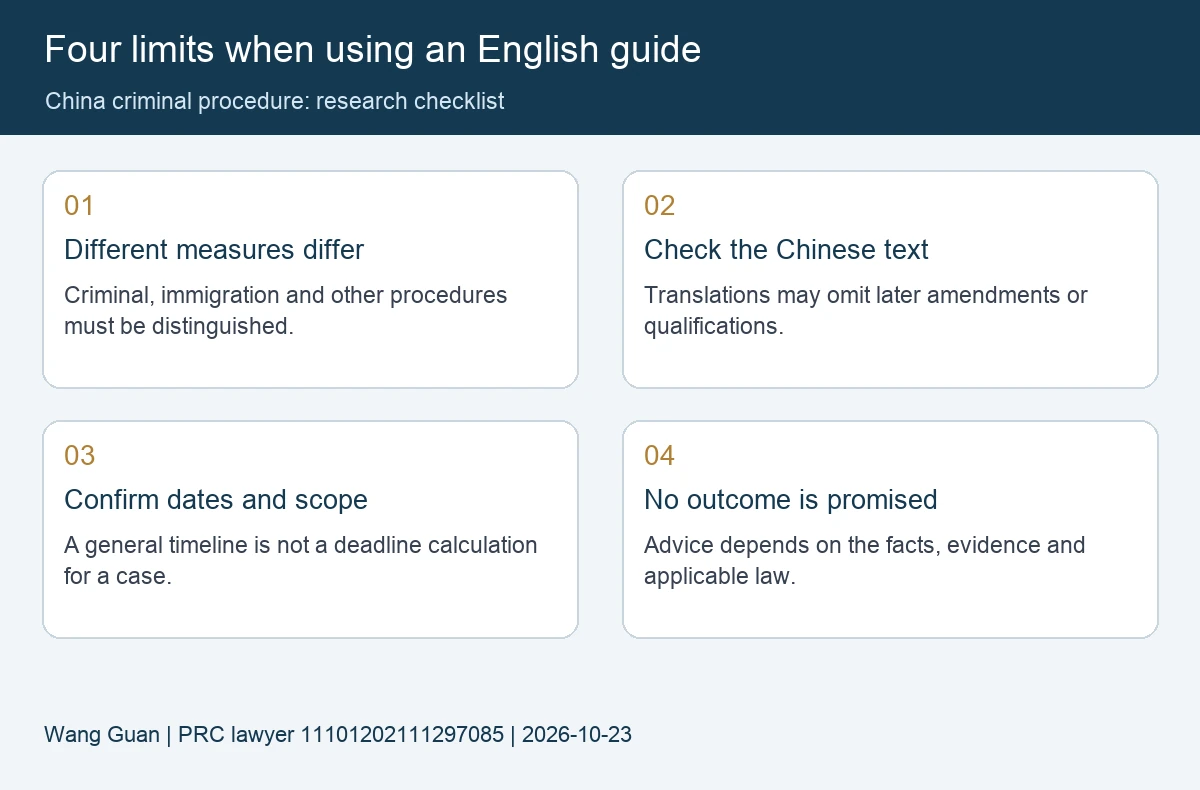
English explanations in this guide are unofficial. The Chinese statutory text and applicable treaties control legal interpretation. The glossary provides working equivalents, not an assertion that Chinese procedures have identical foreign-law counterparts.
9. Revision history
| Version | Date | Changes |
|---|---|---|
| v1.0 | 20 October 2026 | First edition and original resource-page publication. |
| v1.1 | 24 October 2026 | Corrected questioning rights, family-visit routes, consular reporting versus notification, custody and court time limits, appeal exceptions, residential surveillance and glossary terms. Web, Word and PDF revised together. |
Related guides and contact
- Criminal defence for foreign nationals: topic guide
- Cross-border criminal defence and extradition
- Asset return and sharing in China: Articles 51–54
- Wang Guan: profile and practice information
General legal information, not advice on a particular case. Wang Guan | Beijing Hoolaw Law Firm | PRC lawyer’s practice certificate 11101202111297085 | +86 178 1310 8512 | Consultation details.
Contact Wang Guan on WeChat
Prefer to write first? Add Wang Guan on WeChat and briefly describe your question and any deadline.
Scan with WeChat. On the same phone, save the QR image, then choose it from your album in WeChat’s Scan screen.
Website inquiries are received by Wang Guan. Counsel, scope and fees are confirmed in the written engagement.
Materials and engagement details →