External sources open in a new window.
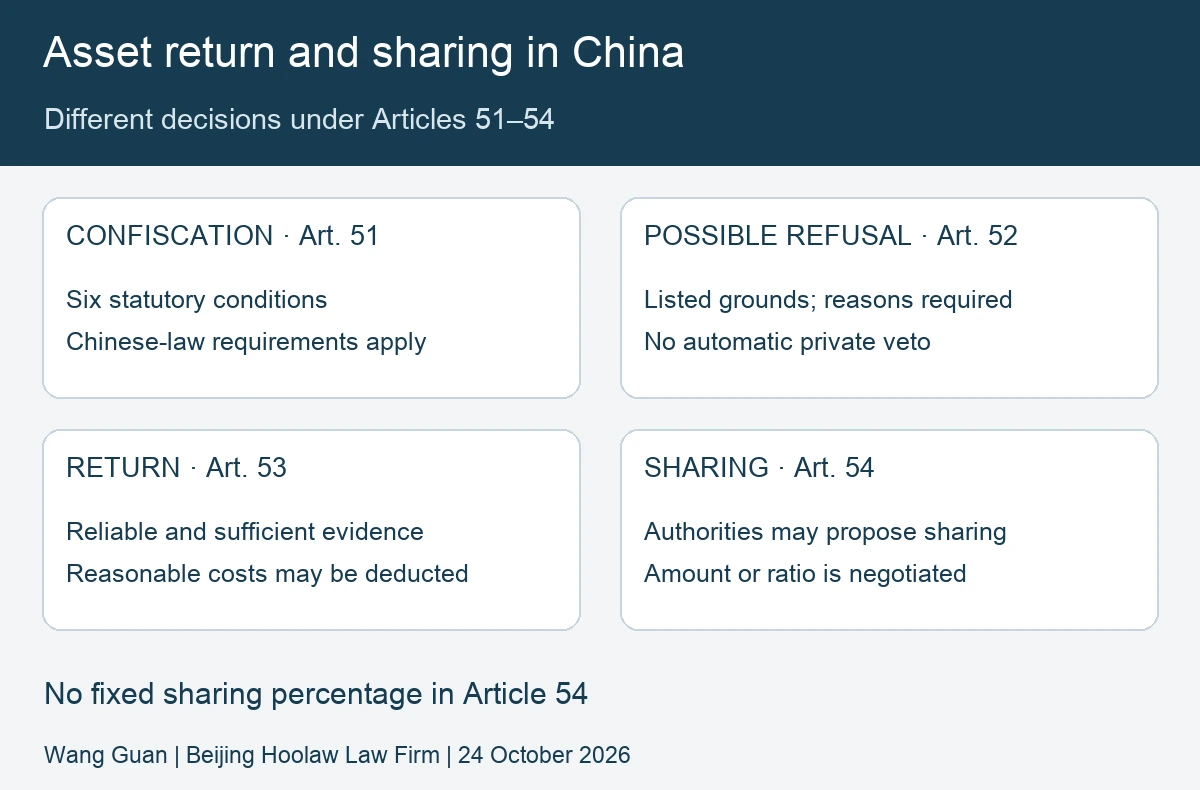
Short answer: China may assist a foreign state with confiscation under Article 51, may agree to return property on the separate test in Article 53, and may propose negotiated sharing under Article 54. Neither return nor sharing is automatic.
By Wang Guan, Attorney at Law | Beijing Hoolaw Law Firm | PRC lawyer’s practice certificate: 11101202111297085. First published: 24 October 2026.
1. Scope: state-to-state criminal assistance
The International Criminal Judicial Assistance Law (2018) covers assistance in criminal investigations, prosecutions, trials and execution, including restraint, confiscation and return of property. This article addresses foreign requests to China under Articles 50–54. Chinese requests abroad are dealt with separately in Articles 47–49.
Articles 5–6 distinguish the external contact authorities, including the Ministry of Justice, from the competent authorities that review requests within their responsibilities. Where there is no criminal judicial assistance treaty, contact is through diplomatic channels. A private claimant does not acquire a right to execute a foreign criminal confiscation order in China merely by sending it to a bank or a court.
Confiscation, return and sharing are distinct questions. The law does not prescribe a universal sequence in which a separate confiscation decision must always be completed before a return request can be considered, or sharing can only be discussed after return. Article 54 concerns requests for assistance with confiscation or return. Applicable treaty provisions, Chinese law and the particular request must be read together.
2. Article 51: six conditions for confiscation assistance
The competent authority may agree to confiscation assistance and arrange execution where it finds the following conditions satisfied:
- The confiscation meets the conditions prescribed by Chinese law.
- The foreign state has adequately protected the relevant rights of interested parties.
- There is property available for execution in China.
- The request and supporting materials describe in detail the ownership, name, characteristics, appearance, quantity and other identifying information of the property.
- The confiscation cannot be executed, or cannot be fully executed, in the requesting state.
- Any other conditions the competent authority considers necessary are met.
A vague reference to “the suspect’s assets” may leave the authority without the identification required by the fourth condition; missing information should be addressed through the request process. The fifth condition concerns execution in the requesting state. It should not be expanded into an unsupported rule requiring proof that every possible remedy in every other country has been exhausted.
Interested-party protection requires attention to ownership and security interests claimed by, for example, a company, lender or family member. An assertion of an interest is not itself a successful objection: the legal basis, supporting evidence and applicable procedure matter.
3. Article 52: grounds on which China may refuse
Article 52 permits refusal of confiscation assistance, with reasons, where:
- A Chinese or third-state judicial authority has made an effective judgment or ruling on the property, and execution is complete or underway.
- The property does not exist, or destruction, loss, sale or transfer makes execution impossible, except where the request targets the property obtained from sale or the property after transfer.
- The person targeted by the request has unsettled debts or unfinished litigation in China.
- Another ground permitting refusal applies.
These are permissive grounds, not an automatic refusal in every case. An outstanding civil claim should be disclosed and assessed; Article 52 does not create a private veto or say that every request is automatically suspended until every civil dispute is resolved. The general rules on assistance and any applicable treaty remain relevant.
4. Article 53: return and reasonable execution costs
For a foreign request to return illegal gains or other property involved, the requesting state must be able to provide reliable and sufficient evidence (确实、充分的证据). If the competent authority finds that Chinese-law conditions are met, it may agree and arrange execution by the relevant case-handling authority.
Before return, the case-handling authority may deduct reasonable costs incurred in executing the request. The statute permits a deduction; it does not make a deduction mandatory or set a standard percentage. The return amount therefore needs to be distinguished from the gross value of property recovered.
Article 53 should be read with Articles 50 and 48, the general provisions and the relevant treaty. It does not, by itself, set out a universal checklist requiring a final foreign confiscation judgment in every possible return case. The documents required depend on the legal route and the request.
5. Article 54: a negotiated sharing request
For foreign requests for assistance with confiscation or return, the external contact authority together with the competent authority may propose sharing. Those authorities negotiate the amount or proportion with the foreign state.
There is no fixed sharing ratio in Article 54, and no automatic entitlement of a private claimant to a negotiated percentage. Do not equate reasonable execution costs under Article 53 with the separate sharing mechanism in Article 54. A well-documented file helps the authorities assess the request; it does not establish a statutory entitlement to a particular share.
6. Confiscation, refusal, return and sharing compared
| Question | Decision and limits | Provision |
|---|---|---|
| Confiscation assistance | Whether to agree to confiscation and arrange execution, subject to the six listed conditions. Freezing is addressed separately in the law. | Article 51 |
| Possible refusal | Whether a listed or other permissible ground justifies refusal; reasons must be given. | Article 52 |
| Return | Whether the evidence and Chinese-law conditions justify return; reasonable execution costs may be deducted. | Article 53 |
| Sharing | Whether to propose sharing and what amount or proportion the authorities and foreign state agree. No fixed statutory ratio. | Article 54 |
7. Domestic recovery and protected property
Criminal Law Article 64 governs recovery or restitution of illegal gains, prompt return of victims’ lawful property, and confiscation of contraband and the offender’s own property used for the crime. It does not establish a universal priority rule under which every Chinese prosecution takes all assets first and a foreign request can receive only a remainder.
Where domestic proceedings, creditors’ claims and a foreign request overlap, identify the property, ownership, restraint orders and effective decisions in each proceeding. Article 52 expressly addresses existing execution, outstanding debts and unfinished litigation. Coordination is needed; the priority and eventual distribution cannot be assumed from the existence of two proceedings alone.
Criminal Law Article 314 concerns concealing, transferring, selling or intentionally damaging property sealed, seized or frozen by a judicial authority where the circumstances are serious. It is inaccurate to state that any disposal automatically satisfies the offence. Preserve records and obtain advice before dealing with restrained property.
8. Preparing a request file: distinguish law from working advice
Article 50 refers to Article 48 for information to be included as needed: the property’s identifying details and location, bank and account details for financial assets, reasons and ownership evidence, copies of relevant legal documents, rules on confiscation or return and interested-party protection, and other helpful materials.
For preparation, counsel and the responsible authorities can use an asset schedule that links each item to ownership records, the alleged offence, the requested measure and supporting decisions. Record competing interests, notice and hearing material, existing restraints, and whether execution in the requesting state is possible. Consider translation, authentication, costs and treaty requirements. This is working advice, not a claim that every listed document is mandatory in every case.
If a person is also facing a criminal case in China, use the criminal procedure guide for foreign nationals to track the separate custody, prosecution and court stages.
9. Common questions
Q: Must China return everything it confiscates?
A: No. Confiscation and return have separate statutory tests. Article 53 allows reasonable execution costs to be deducted before return, and Article 54 permits a request for negotiated sharing. Applicable treaties and the facts must also be considered.
Q: Is asset sharing automatic or fixed at a percentage?
A: No. Under Article 54, the external contact authority together with the competent authority may propose sharing. The amount or proportion is negotiated with the foreign state; the article prescribes no fixed ratio.
Q: Can a private claim automatically block confiscation assistance?
A: No automatic private veto is created. Article 51 requires protection of interested parties, while Article 52 permits refusal where the person concerned has unsettled debts or unfinished litigation in China. The competent authority assesses the request and must give reasons if it refuses.
Q: Is a foreign confiscation judgment enough on its own?
A: No. Article 50 requires a request and supporting information by reference to Article 48, and Article 51 requires the Chinese-law conditions, protection of interested parties, executable property in China and the other listed conditions to be met.
Q: What if the property has already been sold or transferred?
A: Article 52 permits refusal where the property no longer exists or its destruction, loss, sale or transfer makes execution impossible. Its exception preserves requests directed at the property obtained from sale or the property after transfer; identify the requested property precisely.
10. Official sources and translation
- International Criminal Judicial Assistance Law, official Chinese text: Articles 2–6, 8, 47–54; adopted and effective 26 October 2018.
- Criminal Law, official Chinese base text: Articles 64 and 314 cited here. These provisions must be read with any applicable subsequent amendments; this source is not labelled as a 2026 consolidated edition.
The English explanations and translations on this page are prepared for readers of this guide and are not official translations. Consult the official Chinese provisions and any applicable treaty when preparing an actual request.
Related reading and contact
- Cross-border criminal defence and extradition: topic guide
- Criminal procedure in China for foreign nationals
- Wang Guan: profile and practice information
General legal information, not advice on a particular request or case. Contact Wang Guan, Beijing Hoolaw Law Firm: +86 178 1310 8512 | Consultation details.
Contact Wang Guan on WeChat
Prefer to write first? Add Wang Guan on WeChat and briefly describe your question and any deadline.
Scan with WeChat. On the same phone, save the QR image, then choose it from your album in WeChat’s Scan screen.
Website inquiries are received by Wang Guan. Counsel, scope and fees are confirmed in the written engagement.
Materials and engagement details →